Health promotion in the digital era: leveraging potential, reducing risks
Digital environments are increasingly shaping the way people live, learn, work and age, creating both new potential and risks for health and wellbeing. Digital tools are helping people take their steps and stay fit, quit smoking, stay connected with friends and family, and access health information like never before. At the same time, the tech industry profits from addictive design, facilitates health misinformation, and exposes millions, including children, to cyberbullying and harmful content.
The EU has taken action to mitigate the harms of digital tools: the Digital Services Act, the AI Act, and the Action Plan on Cyberbullying are steps in the right direction. But without strong enforcement or health impact assessment explicitly at the centre of digital regulation, the rules risk falling short.
“The health harms of online platforms may not always be obvious to legislators and decision-makers. Presenting evidence in an actionable way should be one of the public health community’s highest priorities if we are to drive meaningful policy change across Europe.”
- Kremlin Wickramasinghe
Regional Advisor, ‘Prevention and Health Promotion Division’ at WHO/Europe
The EuroHealthNet Partnership met in Warsaw to debate the challenges and solutions to health promotion and prevention in the digital era. With a statement launched today, the Partnership makes three overall demands:
- Build digital spaces and hybrid environments that protect and promote health
Digital wellbeing must be embedded across education, healthcare, and public policy, with EU-wide quality standards for health apps, stronger digital literacy, and mental health strategies fit for the digital age. - Make tech platforms accountable for the harm they cause
Strengthen EU digital and AI regulation by applying a ‘do no harm’ to health approach, provide evidence that can be used by legislators, and ensure the full implementation and enforcement of existing EU frameworks. - Protect real-world, human connection and capabilities
Ensure meaningful participation of communities in decision-making processes and invest in offline spaces that support social connection, mental health, skills, and physical activity.
"Digital environments and AI are changing at an accelerating pace, and we cannot afford to lean back. We must work with schools and communities to take measures, while regulating the industry and offering alternative offline environments. The window to shape this is now, while our norms and online habits are still being formed."
- Caroline Costongs
Director of EuroHealthNet
EuroHealthNet’s 2026 Seminar on Health Promotion and Prevention in the Digital Era
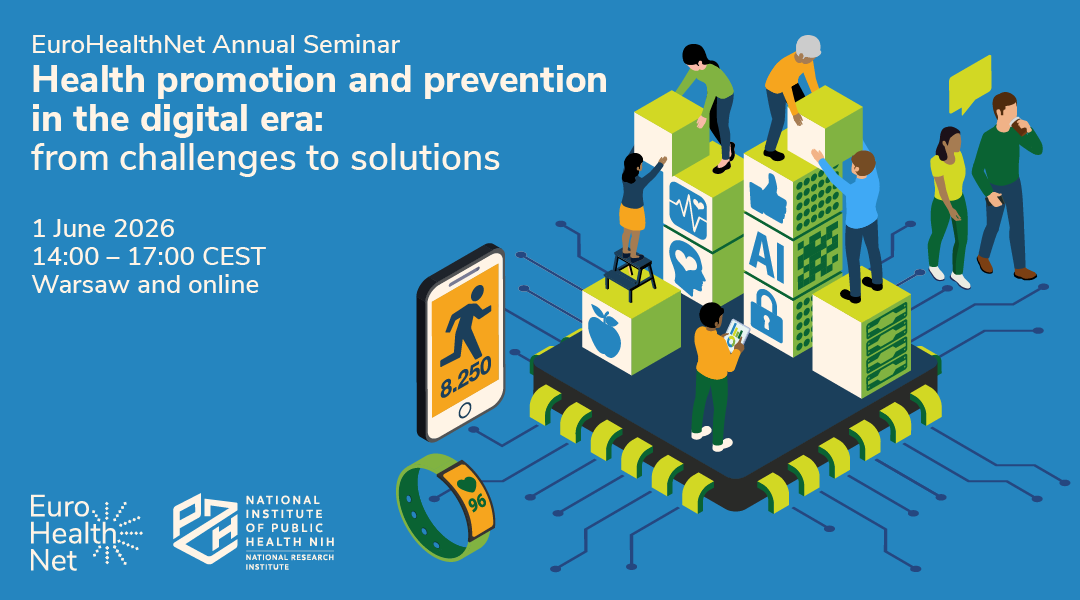
The statement builds on the discussion at EuroHealthNet’s 2026 Annual Seminar, hosted by the Polish National Institute of Public Health – National Institute of Hygiene in Warsaw on 1 June 2026. The Seminar explored how digitalisation and artificial intelligence can support health promotion and disease prevention, while addressing associated risks and inequalities.
Watch the seminar recording here.

Statement
Health promotion in the digital era
Leveraging potential, reducing risks